1. Industry Context: Power Grid Instabilities and Noise Constraints in Asian Telecom Sites
Across many rapidly developing regions in Asia, electrical grid infrastructure varies significantly, with suburban and regional sites experiencing frequent voltage sags, transients, and harmonic distortions. Simultaneously, as operators accelerate 5G and LTE dense urban coverage, numerous wireless base stations and small cells are being installed in close proximity to residential areas, office spaces, and commercial buildings.
In these demanding deployment scenarios, DC power systems for wireless base stations face a dual challenge: they must withstand severe external grid fluctuations without service interruption or hardware damage, while also ensuring that electromagnetic interference (EMI) and operational fan noise do not disrupt sensitive radio frequency (RF) electronics or create noise pollution for surrounding residents. Consequently, rack-mounted DC power systems that combine grid resilience, low EMI, and ultra-quiet operation have become a top selection priority for Asian operators.
2. Key Selection Criteria: Technical Requirements for Low-Noise and Resilient Rack Power
When evaluating 48V rack-mounted rectifier power systems for complex Asian grid and urban environments, telecom engineering teams focus on specific electrical and acoustic parameters:
-
Wide AC Input and Mains Protection: Rectifiers must support a wide AC input range of 85–300 VAC (nominal 185–275 VAC) with an automatic disconnect safety feature for overvoltages exceeding 300 VAC. Internal varistors on both AC input lines absorb transient spikes, maintaining operational continuity despite unstable power grids.
-
Low-Acoustic Noise Design: To comply with urban noise regulations near residential zones, rectifiers utilize temperature- and current-regulated cooling fans. Under nominal input and full load at ambient temperatures $\le 25^\circ\text{C}$, acoustic noise is kept under $20\text{ dBA}$, enabling whisper-quiet operation in noise-sensitive locations.
-
High Voltage Regulation and Low Psophometric Noise: To prevent power ripple from interfering with wireless radio equipment, rectifiers must deliver static voltage regulation within $\pm 0.5\%$ and psophometric noise under $2\text{ mV}_{\text{RMS}}$, ensuring clean DC power delivery.
-
Industrial EMC Compliance: Full compliance with international standards—including ETSI EN 300 386, EN 61000-6-1/2/3/4, and Telcordia NEBS GR-1089 CORE—guarantees robust surge immunity and prevents high-frequency noise from feeding back into local power systems.
3. Architecture and Operations: Modular Reliability and Rack Integration
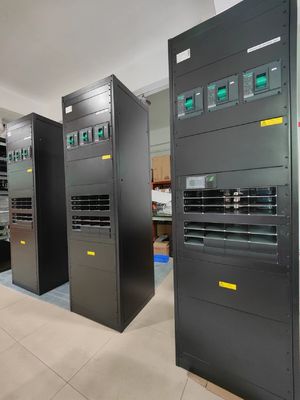
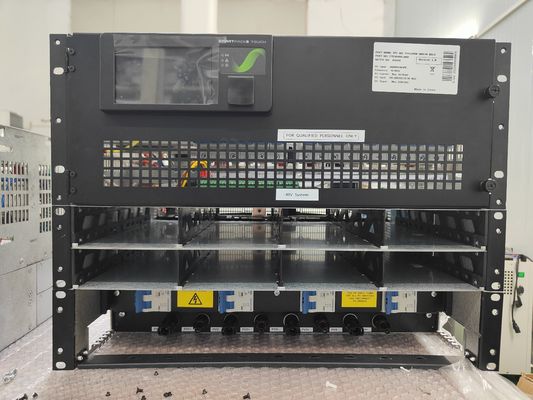
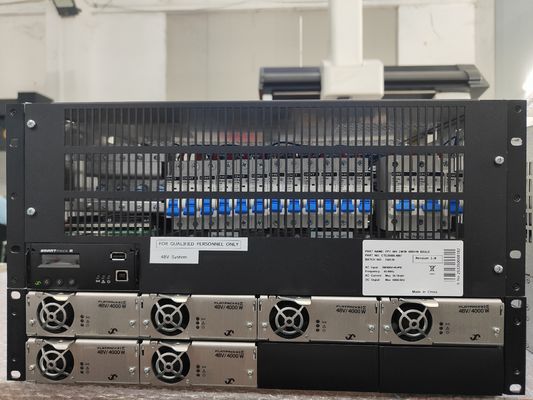
Beyond electrical protection and low noise, standard 19-inch rack-mount compatibility and a compact 1U height allow these rectifiers to integrate seamlessly into standard base station enclosures.
The modular architecture supports live hot-swapping and plug-and-play capability, enabling technicians to perform tool-free replacements on live systems without disrupting connected radio equipment. Supported by a verified Mean Time Between Failures (MTBF) exceeding 350,000 hours (per Telcordia SR-332 standards), this system significantly reduces site visit frequencies and Mean Time to Repair (MTTR).
4. Conclusion and Implementation Strategy
Deploying wireless base stations in Asian markets with volatile grid conditions and high urban density requires DC power solutions that prioritize grid resilience, low noise, and electromagnetic cleanliness. Procurement and network planning teams should evaluate rectifiers based on AC surge protection specs, verified acoustic noise metrics across ambient temperatures, and strict psophometric noise standards to secure reliable, environmentally compliant network power.


 メッセージは20〜3,000文字にする必要があります。